
Why Is H2S Monitoring Critical for Safety?
Hydrogen sulfide (H2S) is a colorable, highly toxic, and flammable gas infamous for its characteristic rotten-egg odor. It forms naturally during the anaerobic decomposition of organic matter by sulfate-reducing bacteria.
Because of these biological mechanisms, H2S is frequently encountered in wastewater treatment plants (WWTPs), anaerobic digestion facilities (biogas/biomethane), agricultural operations, and oil & gas refining.
According to the French National Institute for Research and Safety (INRS), the health hazards of H2S escalate rapidly with concentration: the toxicity of H2S is significant from 10 parts per million (ppm). At 100 ppm, it can cause loss of smell. Beyond 300 ppm, it becomes potentially fatal.
Relying on human senses is impossible for reliable hazard mitigation. Continuous gas monitoring using dedicated analytical instruments is required.
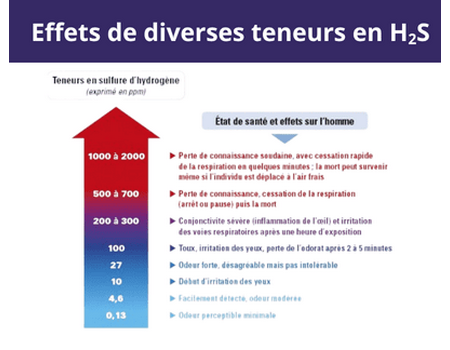
Real-World Hazards: Industrial history includes numerous fatal incidents caused by sudden H2S off-gassing in confined spaces, sewer networks, and sludge processing units.
For instance, a severe industrial accident in 1996 led to the fatal exposure of a worker to sewage off-gassing, according to a report cited by the INSPQ.
Consequently, relying on olfactory perception is unsafe. Detecting an odor indicates existing exposure, while rapid olfactory paralysis at elevated levels severely impairs human detection.
Deploying dedicated analytical instrumentation addresses both safety and odor control challenges. The Micro GC Fusion® enables rapid, real-time gas monitoring, maintaining strict process compliance in applications ranging from sewage sludge treatment to biomethane production and food processing.
Why Is H2S Monitoring Critical for Safety?
Hydrogen sulfide (H2S) is all around us: in natural gas reserves, crude oil, volcanic emissions, and even within the human body. It acts as both a essential biological molecule and a severe hazard when present at elevated levels.
This is where gas chromatography becomes indispensable.
Precise H2S analysis allows process engineers to:
- Verify natural gas compliance before entering distribution grids.
- Detect early-stage pipeline corrosion caused by acid formation.
- Prevent costly machinery breakdowns and compressor failures.
- Ensure fermentation processes stay on track without turning sour or off-spec.
From environmental monitoring to energy production and food processing, H2S is omnipresent—and measuring it accurately requires dedicated expertise.
Hydrogen sulfide is a double-edged sword: dangerous when unmonitored, yet valuable when harnessed. Used as a chemical feedstock in industries like metallurgy and organic synthesis, precise quantification and correct analytical protocols are critical.
Micro GC or GC: Choosing the Right Analytical Solution for H2S
When measuring gas composition—specifically reactive sulfur compounds like hydrogen sulfide (H2S)—gas chromatography stands out as the reference method. Both traditional benchtop GCs and Micro GCs deliver high accuracy, with each technology offering distinct advantages depending on field constraints, sample matrix complexity, and required detection limits.
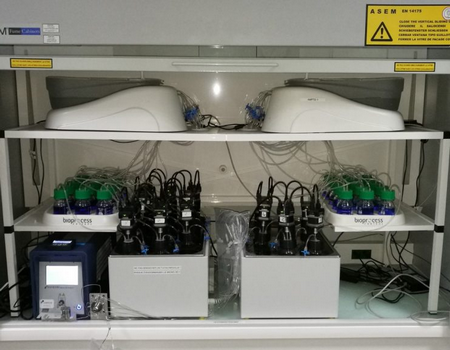
Real-World Application: Sludge Valorization at SIAAPThe SIAAP (Paris Metropolitan Sanitation Authority) generates biogas through anaerobic sludge digestion. To optimize sludge processing and maximize biomethane yield, SIAAP deployed the Micro GC Fusion®. The instrument provides high-speed, online gas composition data, enabling precise process control and efficient sulfur management.
Learn more about SIAAP:
Beyond process-level streams, detecting low ppm or ppb levels of H2S is essential.
In natural hydrogen exploration, underground bacterial reduction pathways frequently yield trace concentrations of sulfur compounds.
Chemlys offers dedicated valve-based GC hardware tailored for low-level H2S detection in demanding matrices.
Integrating an automated autosampler with our customized valve configurations allows for continuous, high-precision natural hydrogen monitoring.
To go further...
A successful analytical setup requires matching the detector technology with a strictly conditioned sample conditioning line. Chemlys delivers tailored technical guidance—from sample conditioning to detector calibration—guaranteeing long-term operational success.
Looking for custom H2S analysis protocols tailored to your application?