Do you know the story of a gas you may use every day in your lab?
For decades, helium has been the gold-standard carrier gas for laboratories and industrial sites utilizing Gas Chromatography (GC and microGC). We will explore the technical reasons behind this undisputed choice later in this article. But first, let’s look back at the origins of this everyday laboratory gas to better understand the high stakes behind its recurring shortages and skyrocketing costs. Bit by bit, its systematic use is being questioned. Here is a look at the fascinating history of helium, its complex global market, and the strategic reasons driving modern laboratories to transition to hydrogen.
A Gas Discovered in Space
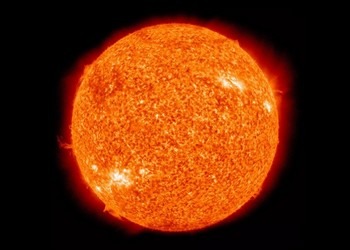
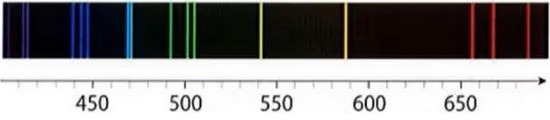
Fait exceptionnel dans l’histoire des sciences : l’hélium a été découvert dans l’espace bien avant d’être identifié sur Terre. Le 18 août 1868, lors d’une éclipse solaire totale en Inde, les astronomes Jules Janssen (français) et Norman Lockyer (britannique) observent indépendamment une raie jaune inconnue dans le spectre de la chromosphère du Soleil. Lockyer nomme ce nouvel élément « hélium », du grec hélios (Soleil). Ce n’est que plus de 20 ans plus tard, en 1895, que l’hélium sera officiellement isolé sur Terre.
Helium emission spectrum – wavelength in nm
Earthly Origins and Limited Resources: A Slow-Motion Formation
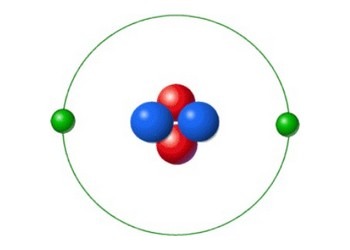
Unlike hydrogen or oxygen, helium is not a renewable resource on a human timescale. On Earth, helium (specifically the Helium-4 isotope) is formed through the exceptionally slow radioactive decay of heavy elements, primarily uranium and thorium, trapped deep within the Earth's crust.
This formation process takes millions of years. As it forms, the gas migrates toward the surface and becomes trapped beneath impermeable rock layers, frequently mixing with natural gas deposits. Once extracted and released into the open air, its extreme lightness causes it to escape Earth’s gravity, losing it to space forever. We are currently consuming a resource in mere decades that took millions of years to form—something to think about the next time you adjust your split ratio!
Helium... and the Fossil Fuel Industry
Pure, ready-to-mine helium deposits do not exist. Instead, helium is extracted strictly as a byproduct of the natural gas industry. When a natural gas field contains a commercially viable concentration of helium (typically between 0.3% and a few percent), the helium is separated during the Liquefied Natural Gas (LNG) production process.

Consequently, the global helium supply is intrinsically tethered to fossil fuel extraction. Its carbon footprint is remarkably heavy, relying entirely on extensive oil and gas infrastructure, highly energy-intensive cryogenic purification (helium liquefies at an extreme -269°C), and a highly complex global shipping network.
Global Consumption: Key Market Figures
The global helium market operates under permanent tension. To understand the scale, here is a snapshot of the market dynamics as of 2023: Approximately 170 million cubic meters annually..
- Top Producers: The market is historically dominated by the United States, closely followed by Qatar, Algeria, and Russia.
- The French Context: France produces zero commercial helium. In 2023, French imports exceeded 6 million m³, with the vast majority (87%) sourced from Algeria.
- Top Consumers: While analytical techniques (like GC) and research use a significant share, the largest volumes are absorbed by medical imaging (cooling MRI magnets, ~17% of the market), the semiconductor industry, and specialized welding.
Helium in GC and microGC: Performance and Safety
In Gas Chromatography, helium has long been the carrier gas par excellence. Why is this choice so obvious for users of advanced analyzers, such as those provided by Chemlys?
- Uncompromising Safety: Helium is an inert, non-flammable, and non-toxic gas. It presents absolutely zero risk of explosion in a laboratory setting.
- Exceptional Performance: It boasts very high thermal conductivity (second only to hydrogen). This characteristic is paramount for Thermal Conductivity Detectors (TCD), which equip the vast majority of microGC instruments. Thanks to its small molecular size, it enables high column velocities, delivering excellent component separation (sharp chromatography) alongside high baseline sensitivity.
This performance dynamic is perfectly illustrated by van Deemter curves, which compare the efficiency of the main GC carrier gases. Graph showing the evolution of Height Equivalent to a Theoretical Plate (H) vs. linear velocity (u) for Nitrogen (blue), Helium (red)and Hydrogen(H2), (green)Peak column efficiency is achieved at the lowest H value.
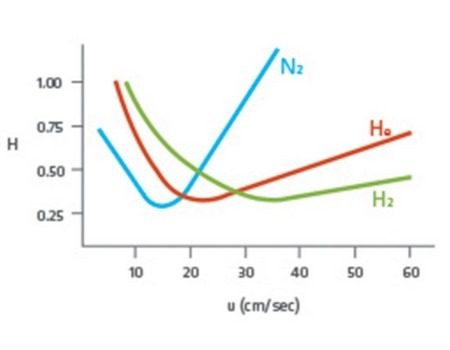
- Nitrogen (N2) Offers excellent efficiency at very low linear velocities, but efficiency drops abruptly as speed increases, rendering it highly unsuitable for fast analysis.
- Helium (He) : Serves as the optimal standard compromise, achieving peak efficiency at intermediate speeds.
- Hydrogen (H2) : Features the flattest curve with its minimum shifted furthest to the right. This allows laboratories to utilize much higher gas flow rates (enabling significantly faster analyses) while maintaining superb separation efficiency.
Price Evolution Since 1950: From Artificial Abundance to Market Shortage
Following World War II, the United States aggressively stockpiled helium—deemed a critical strategic resource for the Cold War and the Space Race—in the federal Cliffside Reserve in Texas.
Following World War II, the United States aggressively stockpiled helium—deemed a critical strategic resource for the Cold War and the Space Race—in the federal Cliffside Reserve in Texas.
Le tournant majeur a lieu en 1996 avec le Helium Privatization Act. Pour rembourser les dettes liées à ce stockage, le gouvernement américain a décidé de liquéfier cette réserve fédérale à des prix artificiellement bas. Cette abondance a rendu l’hélium extrêmement bon marché dans les années 2000. Mais à mesure que la réserve s’est vidée (elle est aujourd’hui presque épuisée), l’offre mondiale a chuté. Depuis les années 2010, le marché subit ce qu’on appelle les « Helium Shortages » (pénuries 1.0, 2.0, 3.0…). En conséquence, son prix a explosé, se multipliant parfois par 3 ou 4 sur de courtes périodes.
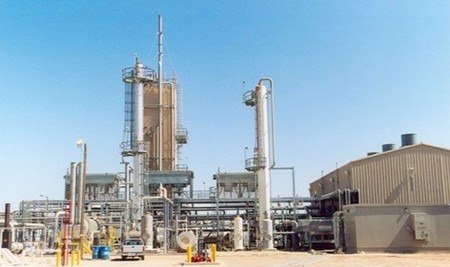
Cliffside Reserve in Texas (Photo by U.S. Bureau of Land Management)
The Strategic Transition to Hydrogen
Faced with exorbitant costs and severe supply chain disruptions caused by geopolitical instability, reliance on a handful of producing nations, and embargo risks, modern laboratories are executing a strategic shift toward hydrogen.
An Ecological and Logistical Upgrade
- Logistical Autonomy: Hydrogen can be produced directly on-site, on-demand, using a hydrogen generator via water electrolysis. This eliminates the heavy logistical burden of managing high-pressure cylinders, ongoing rental contracts, and dependency on international freight.
- Decarbonization: When hydrogen is generated on-site using renewable electricity, its carbon footprint drops to near zero, entirely decoupling laboratory operations from the fossil fuel industry.
... A Strategic Analytical Advantage
- Superior Chromatographic Performance : As shown by the van Deemter curve, hydrogen in GC allows for faster analysis run-times than helium without sacrificing high-resolution separation.
- Controlled Safety: While hydrogen is inherently flammable, modern laboratory generators and state-of-the-art GC/microGC systems feature robust, advanced safety protocols (such as continuous leak detectors and extremely low internal gas storage volumes). These integrated safeguards make the use of hydrogen highly secure and manageable in any standard laboratory environment.