
The invention of the micro GC can be attributed to S.C. Terry, J.H. Jerman, and J.B. Angell¹. In 1979, this team published the very first scientific paper demonstrating the fabrication of a complete gas chromatograph on a silicon wafer.
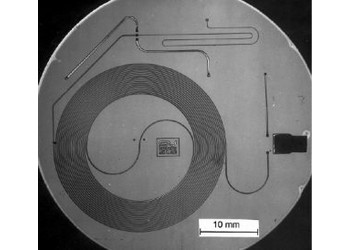
Premier Micro GC on a chip (1979)
Un système d’analyse de gaz miniature a été construit sur la base des principes de la chromatographie en phase gazeuse (GC). Les principaux composants on été fabriqués dans le silicium en utilisant la photolithographie et les techniques de gravure chimique, ce qui permet des réductions de taille par 1000 rapport aux instruments de laboratoire classiques. Le système de chromatographie est alors constitué d’une « soupape » d’injection de l’échantillon dans une colonne capillaire de séparation de 1,5 m de long, qui sont fabriqués sur une plaquette de silicium de substrat. Le détecteur de conductivité thermique (TCD) de sortie est fabriqué séparément par lots et monté de manière intégrable sur la plaquette. Les séparations de mélanges d’hydrocarbures gazeux sont réalisées en moins de 10 s !
From its inception, the system was designed with ambitious applications in mind: portable ambient air quality monitors, implanted biological experiments, and deep-space planetary probes. As we will see, these early ambitions soon became a reality.
Founded in 1981, Microsensor Technology, Inc. (MTI Analytical Instruments) became the definitive pioneer in utilizing Micro-Electro-Mechanical Systems (MEMS) to develop miniature gas chromatographs. Interfaced directly with a laptop, the early Micro GC was, from the very beginning, designed for rugged field operations.
In 1990, William R. Higdon acquired MTI when the company was on the verge of bankruptcy. At the time, MTI possessed its own fabrication facility for silicon sensors and micro-valves. It was during this era that the core technological fundamentals were cemented. The analytical module was defined by a powerful trio:- A micro-machined silicon injector- A capillary column- A nano-TCD detectorRemarkably, over 30 years later, this highly innovative core concept remains the industry standard.
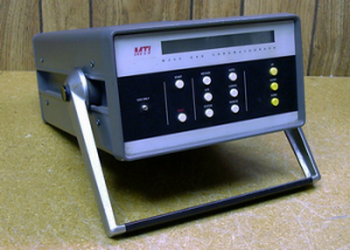
Photo of the first MTI analyzer
MTI Analytical Instruments successfully deployed its products across portable applications, conventional laboratory settings, and demanding industrial environments for online applications (such as off-shore drilling, emissions measurement, and continuous process monitoring). As a true pioneer, MTI was the first company in the world to successfully execute gas chromatography directly in the field.
In 1994, MTI launched the P200, the first truly portable micro GC equipped with a built-in gas reserve and battery. They quickly followed up with the P200H, which featured a heated sample inlet (up to 100°C), unlocking the ability to analyze Volatile Organic Compounds (VOCs) and molecules with higher boiling points (up to 220°C).
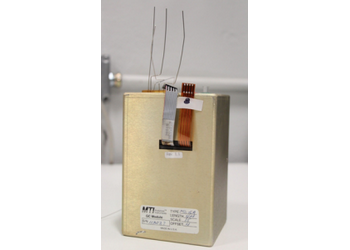
Photo of an MTI analytical module
With only a few minor modifications, it was this exact MTI P200 model that was selected by NASA and loaded onto the Space Shuttle Columbia on July 1, 1997.
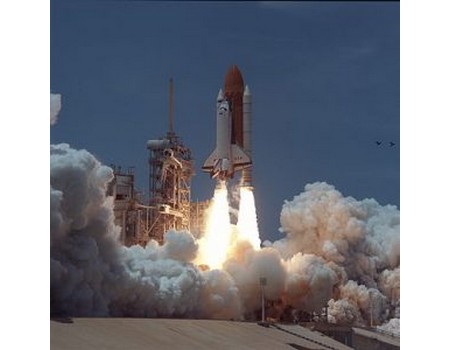
Liftoff of the STS-94 space mission rocket
During the STS-94 mission, the Micro GC was successfully utilized to analyze experimental combustion gases directly on board the space shuttle, proving the extreme reliability of MEMS technology in the harshest conditions imaginable.
By 1998, MTI had grown into a specialized 45-person company entirely dedicated to manufacturing micro-chromatographs.
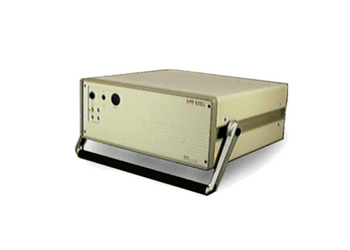
Micro GC MTI 4 modules
Eventually, MTI was acquired by Hewlett-Packard (HP), which continued to market the same micro GC models (M200, P200, P200H) for several years. Development was then relocated to the Little Falls Analytical Division in Wilmington, USA. This facility birthed the next major generation: the M3000.
Hewlett-Packard's analytical division later became Agilent Technologies, which successfully continued marketing the Micro GC 3000 series globally.
The technology changed hands once more in 2010, when INFICON acquired the Micro GC portfolio.
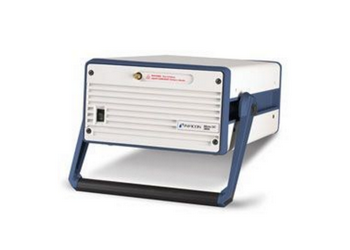
INFICON 3000 2 modules
In 2014, INFICON pushed the technology forward again by introducing the first micro GC featuring a temperature-programmable column. This model, the Micro GC Fusion, represents the latest, most advanced iteration in the long and prestigious lineage of MTI's original micro GC technology.

(1) Reference: A gas chromatographic air analyzer fabricated on a silicon wafer. IEEE Transactions on Electron Devices. 1979;26:1880–6.