
In gas chromatography—and Micro GC in particular—external calibration is essential to ensure accurate and repeatable quantifications.
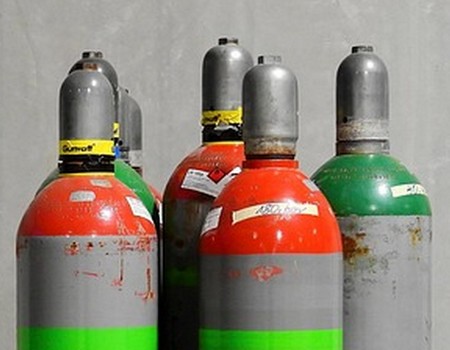
While standard gas cylinders offer the most practical solution for calibrating your analyzer, determining their exact composition can be challenging. Multiple physicochemical and technical parameters must be balanced to obtain a reliable, stable, and cost-effective gas standard.
However, it remains to define the composition of its standard bottle! The question is not so simple and different factors need to be taken into account.
Can All Compounds Be Mixed in a Single Cylinder?
Yes, standard gases may contain 1 to more than 30 compounds in various concentrations. It is therefore not necessary to make bottles for each compound individually.
However, it is sometimes necessary to have several bottles to obtain all of its sample. This is particularly the case for compounds with reactivity, for example, some sulphur compounds.
Reactive species—such as certain sulfur compounds (H2S, mercaptans) or ammonia (NH3) can interact with other components or adsorb onto cylinder walls. These mixtures often have shorter shelf lives. Keeping reactive compounds in a separate cylinder preserves the long-term stability of your primary standard gas matrix.
Physicochemical properties limit gaseous mixture concentrations.
Heavy hydrocarbons (>C6) or solvents (e.g., Toluene) exist as liquids under ambient conditions or condense at moderate pressures.
Consequently, cylinders containing heavy or semi-volatile compounds are delivered at lower maximum pressures or reduced concentrations to prevent condensation.
Choosing the Right Matrix (Balance Gas)
Where possible, it is recommended to select the same matrix as the sample as the background gas. The most common background gases are nitrogen, helium and argon. In microGC, depending on the application, the background gas may also be methane.
Determining Compound Concentrations
Gas standard concentrations are typically expressed as molar fractions (ppb, ppm, or %), as this unit remains independent of pressure and temperature variations.
Micro GC is an analytical technique known for its linearity and stability. Thus, for many applications, only one calibration point per compound is often sufficient. A concentration value close to the expected normal value in its sample is then selected to obtain a quantification with the lowest uncertainty.
When Do You Need Multiple Calibration Cylinders?
Wide Concentration Ranges:
If an analyte varies across a broad dynamic range (e.g., Methane production from 0% to 45%), a two-point calibration (low and high) is recommended.
In this case, two standards are usually used: a low and a high value. Note on Low Points: Choose a low standard safely above the instrument’s Limit of Detection (LOD). Calibrating too close to the LOD increases measurement noise, impairing calibration linearity.
For example, the application is intended to determine a methane production of 0-43%. The low calibration point can be set to 50 ppm and the high to 45%. The calibration curve is a straight line through zero.
Matrix Shifts During Process Steps:
In microGC and mainly on the molecular sieve column, the quantification of some compounds can be affected by a "matrix effect". Indeed, in the analysis of a process whose matrix between the beginning and the end passes from hydrogen to methane, it is noted that the quantification of nitrogen or CO2, for example, can be affected, even without any change in concentration for these compounds. This will be the subject of a subsequent article. In this case, it may be necessary to have several standard cylinders, one for each matrix of its application.
Key Specifications: Validity, Accuracy, and Cylinder Size
Shelf Life / Validity
The certificate issued with the cylinder shall indicate a period of validity of the mixture.
A gas mixture can be stable for up to several years depending on its composition. Similarly, the stability of the mixture is guaranteed under storage conditions, usually between -10 and 50°C for example, in direct sun shelter.
Today, control of the entire production chain of the gas standards ensures stability over time, even for low levels.
Accuracy
The accuracy of the mixture is defined by the difference of achievement and uncertainty. The accuracy of the mixture is mainly due to two parameters:
A difference in concentration between the requested concentration and the realized concentration. This parameter depends on the production technique. A tolerance of 5% is commonly accepted.
Uncertainty: maximum difference between measured concentration and true concentration. This is indicated by a 95% confidence interval according to ISO 6141. This parameter depends on the capacity of the measurement technique. An uncertainty of 1% to 2% is generally accepted for chromatography measurements. Sometimes, depending on the compounds and the desired concentration, the minimum possible uncertainty is 5% or more.
NB: High precision bottles with less than 0.1% uncertainty are achievable. These, on the other hand, are much more expensive and generally not necessary for the calibration of our analysers.
Several levels of accuracy are generally available in gas tankers to cover all needs.
For the calibration of your microGC, a 5 to 10% implementation gap and an uncertainty of 1 to 2% are sufficient for a good calibration.
Bottle size
Standard bottles are available in different sizes from 1L to 50L with pressures up to 200 bars.
In microGC, although calibration is not very common because the analyser is known for its stability, one can move towards a small bottle. However, it is interesting to learn about the prices of several volumes because sometimes between a B10 and a B20, there is very little difference in price due to the complexity of making mixtures in a small volume, especially in low content (needs for successive dilutions, etc.).
Good practices
Beware of contamination!
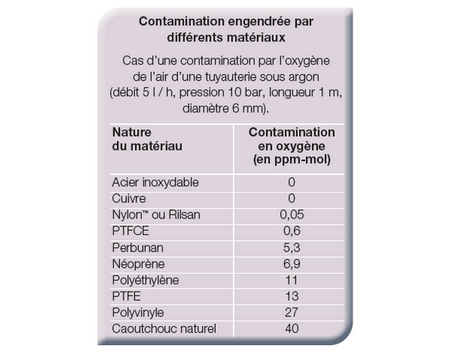
The standard bottle as well as all elements from the bottle to the connection to your analyser can be contaminated. In fact, ambient air and humidity in particular, due to a phenomenon of backscattering are common contaminants. This is explained by the difference in partial pressure between gases on both sides of the walls.
To safeguard your calibration integrity:
– Use equipment adapted to your application: the choice of material or treatment may affect the entire application. Materials must be non-permeable, non-porous, non-reactive.
– Ensure that the components in contact with the gas are leakproof and clean at any point in the installation. Please note, we advise against checking watertightness with liquid (type Snoop).
– Purging all of your facility during commissioning to remove air and residual impurities.
Source image : Air Liquide
Be careful with low vapour pressure mixtures!
These mixtures present a risk of condensation during injection. Heating transfer lines is a good solution to limit this risk and ensure the integrity of the injected mixture.
In summary
For my micro GC calibration, ideally I need:
- 1 Standard Cylinder
- containing all required analytes.
- Concentrations aligned with expected process values.
- A balance gas identical to your actual sample stream.
- A dedicated, high-purity pressure regulator.
If my application sweeps a very wide range of concentration for my compounds, I should achieve several calibration points and therefore have several gaseous standards.
If I wish to analyze samples containing significant gas phase contents of compounds not available in gaseous form or under very limited conditions, I should use another calibration method.
Other calibration methods are actually available, this may be the subject of a future article!